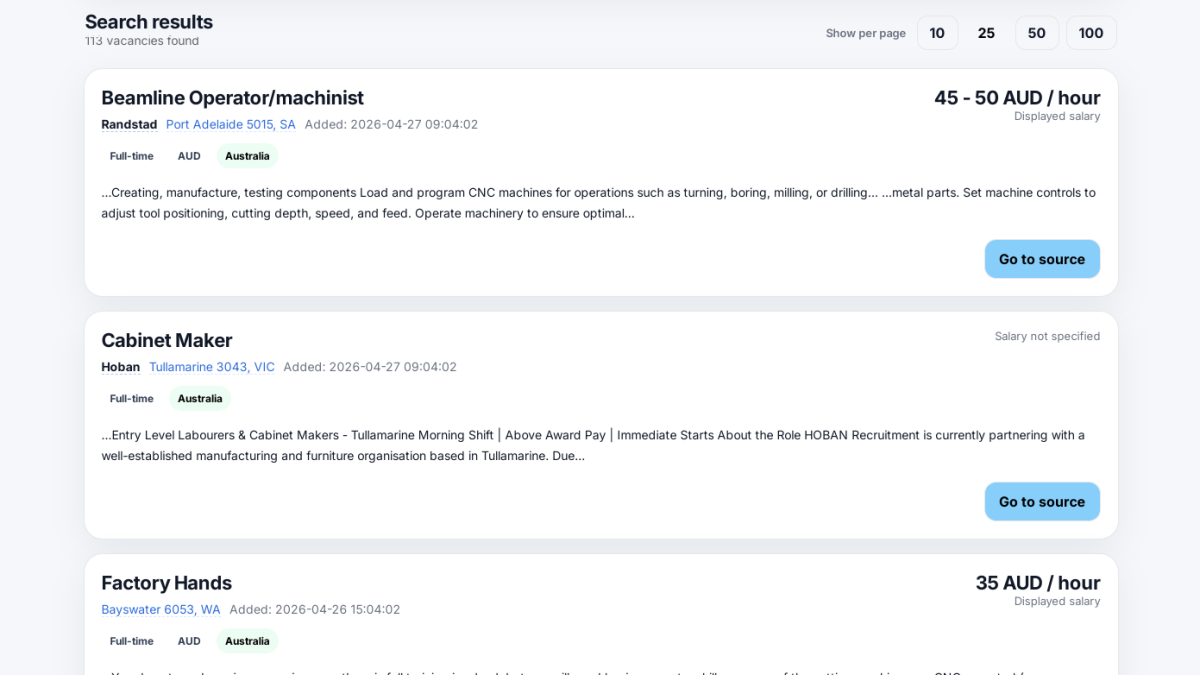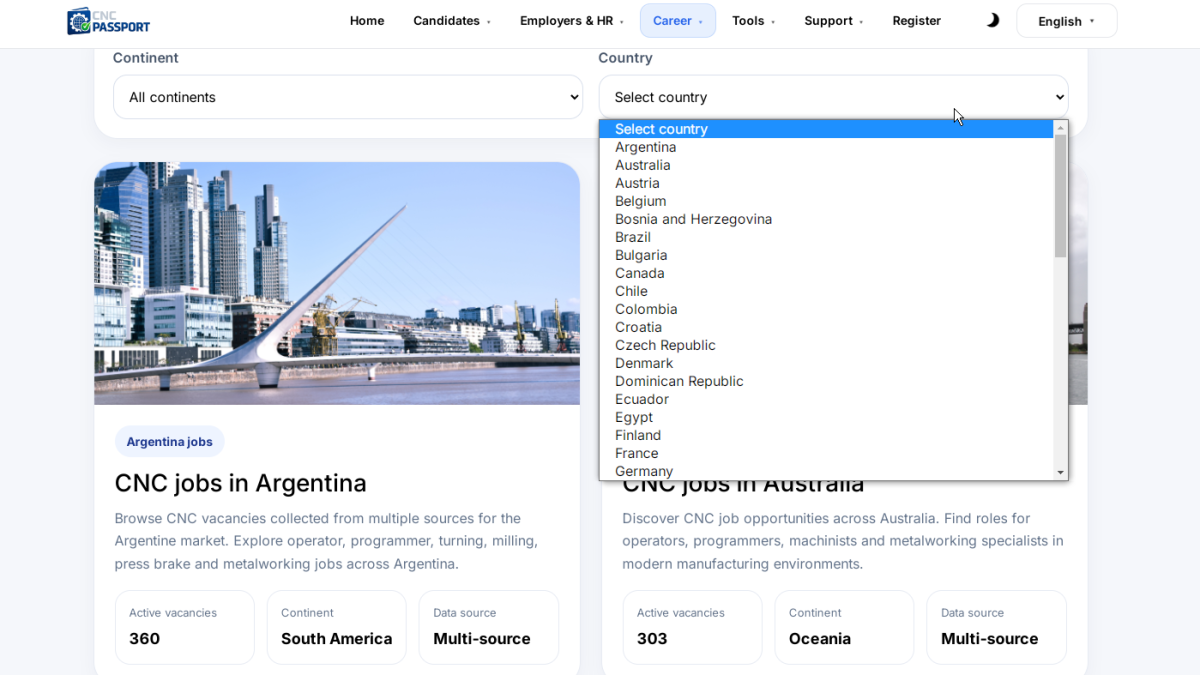
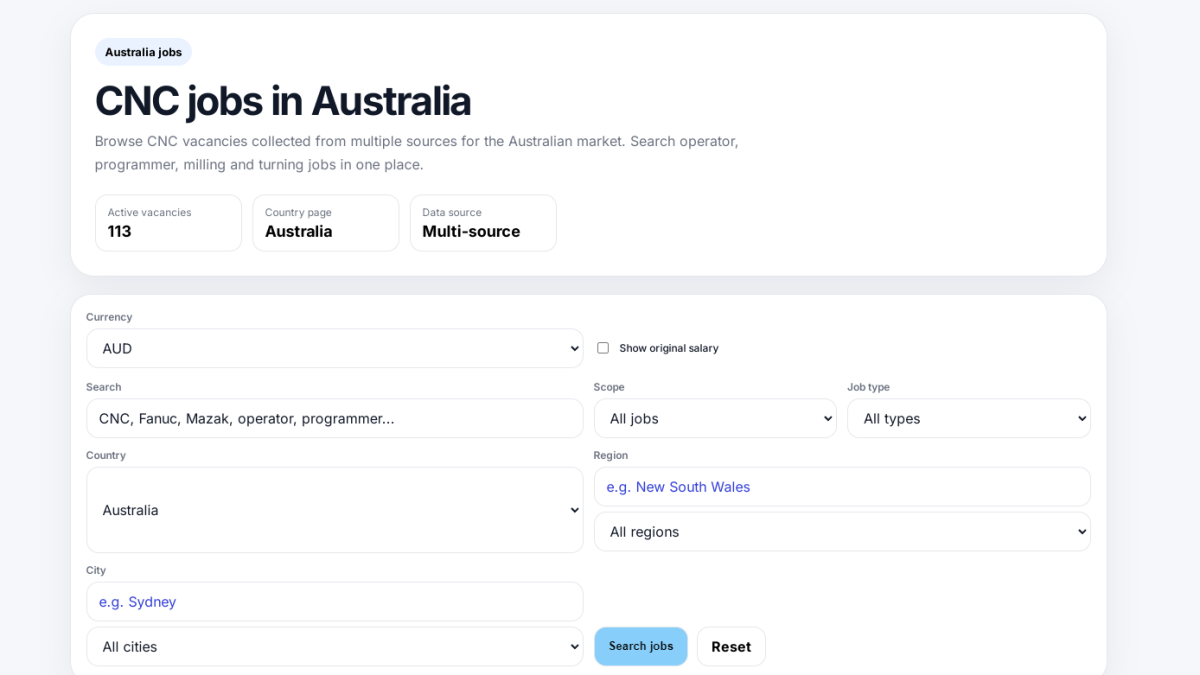
The CNC jobs worldwide section on CNC Passport is built for people who search for CNC work and want to look beyond a single country, comparing different job markets in one place. It is not just a list of job ads. The main idea is to give users a practical entry point: choose a country, open the vacancy page, and quickly understand which CNC specialists are currently in demand.
This format is especially useful in the CNC field, where job titles, requirements, and demand levels can vary strongly from one country to another. In one region employers may more often search for a CNC operator, while in another they may use CNC machinist, CNC programmer, setter, turner, miller, or CAD/CAM specialist. If a candidate checks only one job source, part of the market can remain invisible. CNC Passport collects vacancies from multiple sources and helps users browse them through country pages.
Who these CNC vacancies are for
First of all, the section is for CNC operators, setters, and programmers who are looking for a new position or evaluating relocation opportunities. If a specialist works with milling or turning machines, writes CNC programs, sets up controllers, reads technical drawings, uses measuring tools, or works with CAM systems, these vacancies help them understand where their skills may be in demand.
The section is also useful for experienced machinists who want to compare requirements across countries. For example, one market may more often require Fanuc, Siemens, Haas, or Heidenhain experience; another may focus on 3-axis machining; another may show demand for 5-axis machines; and some employers may look for a universal specialist who can set up the machine, write programs, and control part quality.
A separate audience is beginners and CNC students. Job descriptions show real employer requirements: which skills appear most often, which roles are available with limited experience, where English or a local language is required, and where practical shop-floor experience matters more. This helps people avoid learning blindly and focus on the real needs of the market.
Why browse vacancies by country
The Explore CNC jobs by country page helps users choose a country and browse active CNC vacancies collected from multiple sources. This approach is convenient when a person does not yet know where to search: in their own country, in a neighboring country, or in the international market.
For a candidate, it is a way to compare directions quickly. They can open several countries and see where there are more active offers, which positions appear more often, and how frequently employers search for operators, programmers, setters, or CAM specialists. Even without applying immediately, this gives a practical view of the market.
For people planning relocation, this is especially important. Vacancies show not only company names, but also the language of the market: which job titles are used, which requirements are treated as standard, and which skills should be highlighted in a resume. Sometimes a specialist assumes their experience fits only one role, while in another country the same work may be described with a different job title.
Who else can benefit from this section
CNC jobs worldwide is not only for job seekers. It is also useful for employers, recruiters, and HR specialists who want to understand what the CNC labor market looks like in different countries. Vacancies show how other companies describe requirements, which skills they emphasize, which positions are actively published, and how demand changes.
Training centers and CNC instructors can use this section to compare their programs with the labor market. If vacancies repeatedly mention reading G-code, tool setup, Fanuc experience, dimensional inspection, tool compensation, workholding, and CAM preparation, these topics should not remain theoretical checkboxes. They should become practical skills.
The section can also help workshop owners and manufacturing companies. Even if they are not searching for a job, they need to understand which specialists are in demand in other regions, which competencies are becoming standard, and how competitors describe CNC roles.
Why an archive of older vacancies matters
CNC Passport also has a separate Archived CNC jobs section. It is used for older, no longer current vacancies that should not be treated as active offers for applying. But that does not make these listings useless.
The archive helps users search and analyze previous vacancies by country and date. A user can choose a country and a date to load archived vacancy cards. This is useful when someone wants to see which offers existed before, which roles appeared regularly, how requirements changed, and which companies have previously hired CNC specialists.
Older vacancies are especially valuable for market research. Even if a job posting is closed, it can show typical responsibilities, common job titles, repeated experience requirements, skills, and equipment. For a CNC specialist, this helps prepare a stronger resume and understand which competencies are worth developing.
The archive does not replace active vacancies
It is important to understand the archive correctly. Archived vacancies should not be viewed as current job offers. They may be closed, removed from the original source, or no longer relevant for the employer. For job search and applications, users should start with the active pages on CNC jobs worldwide.
The archive has a different purpose: analysis, comparison, and information search. It shows the history of the market, not only its current state. In CNC professions this is useful because demand for specialists often repeats. If a company or region has regularly published similar vacancies, it makes sense to keep watching that direction.
How to use the section in practice
The simplest scenario is to open CNC jobs worldwide, choose a country, and review active vacancies. After that, users can compare several countries, look at job titles, requirements, and recurring skills. If they are interested in market history, they can move to Archived CNC jobs and view the archive by country and date.
For a CNC operator, this is a way to find new offers. For a programmer, it shows where their controllers, CAM systems, and experience are relevant. For a setter, it highlights manufacturers that need practical skills in launching parts. For a student, it clarifies what to learn first. For a recruiter or employer, it helps compare wording and market expectations.
CNC jobs worldwide helps users look at the CNC job market more broadly: not as a random set of listings, but as a map of demand by country. The archive keeps older vacancies as a source of data so they can still be used for search, comparison, and professional analysis.