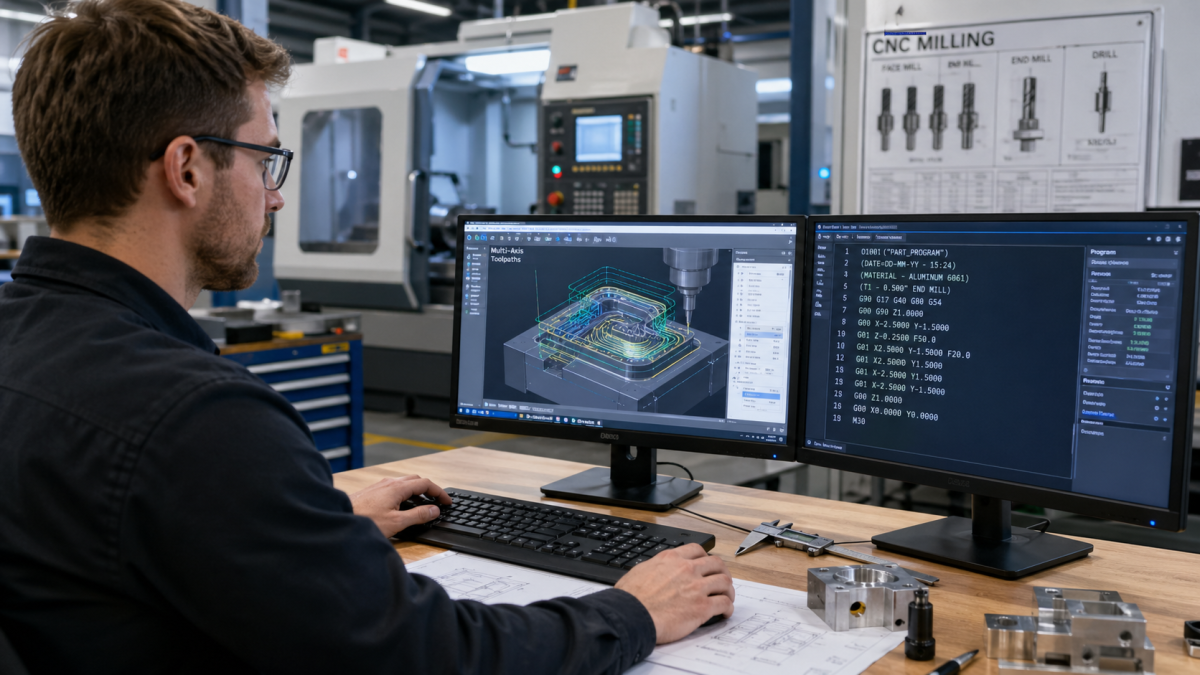
Hiring a CNC programmer almost always carries production risk. A good specialist helps launch parts more consistently, reduce errors, save setup time, and support quality. A weak candidate may sound confident in an interview but create problems after starting: incomplete operation preparation, weak understanding of fixtures, poor communication with the shop floor, documentation gaps, or programs that are hard to run safely on real equipment.
Verifying CNC programmer skills before hiring should not become a random exam on terminology. The employer needs to understand something else: how the person thinks about manufacturing, whether they can connect drawing, material, tooling, machine, quality, and the real constraints of the shop floor. It is important to assess not only technical literacy, but also the ability to work with people, processes, and responsibility.
This article helps employers, recruiters, and hiring managers build a CNC programmer assessment that does not rely only on resumes, tenure, and confident answers. It is about a practical evaluation system: what to clarify before the interview, what evidence to request, which questions to ask, and how to understand where the candidate is truly strong.
First define what kind of programmer you need
The mistake often starts with a role title that is too broad. CNC programmer means different things in different companies. In one company, the programmer only prepares CAM operations using established templates. In another, the programmer participates in tool selection, writes process documentation, supports setup, analyzes quality problems, and is responsible for launching a new part. In a third company, the role combines programming, setup, operator training, and communication with engineering.
Before assessing a candidate, describe the real role. Otherwise the interview will assess the wrong thing. One candidate may be an excellent CAM programmer for serial parts but weak for prototype work. Another may be a strong shop-floor practitioner but need development in documentation and standardization.
It is useful to answer in advance:
- which machine types and operations are included in the role;
- whether the candidate needs only to program or also participate in launch;
- which materials, tolerances, and part types are most common;
- how standardized the tools, fixtures, and CAM templates are;
- who checks the program before production;
- which mistakes in this role are most expensive;
- what level of communication with shop floor, quality, and engineering is expected.
This role profile makes verification fairer. You assess the candidate not by an abstract idea of a strong programmer, but by the tasks they will actually need to perform.
Do not trust only a list of software and controls
A CNC programmer's resume often lists CAM systems, controls, machine types, and industries. That is useful, but not enough. Knowing the names does not show depth. The candidate may have worked in the system but only edited existing templates. They may have seen complex parts without being responsible for the machining strategy. They may have launched programs beside an experienced setup specialist without making key decisions.
Instead of asking only whether the candidate worked with a system, clarify the level of responsibility:
- which operations the candidate prepared independently;
- which decisions they made alone and which they aligned with a process engineer or setup specialist;
- how they checked their work before handing it to the shop floor;
- which errors they encountered and how they changed the process afterward;
- what documentation they delivered together with the program;
- how they communicated with the operator or setup specialist during first launch.
A strong candidate can usually explain their process without overperforming confidence. They do not only say that they programmed; they show how they thought, what they checked, and where they saw risk.
Ask for an anonymized portfolio or work cases
A CNC programmer portfolio can be useful if it does not violate confidentiality. Do not ask for customer drawings, closed models, part numbers, or internal process data. That is a bad signal for both the candidate and the employer. It is better to ask for anonymized cases: part type, material, general task, candidate role, constraints, result, and conclusions.
A good work case can include:
- what the production task was;
- which part of the work was the candidate's responsibility;
- what constraints existed around material, deadline, tolerance, tooling, or equipment;
- how the candidate chose the machining approach;
- how they checked the result before handing it to production;
- what changed after the first launch;
- what lesson the candidate took from the work.
Even without revealing secrets, such a case shows a lot: independence level, careful thinking, quality understanding, attitude to feedback, and ability to explain technical decisions.
Assess thinking, not only correct answers
CNC programming rarely comes down to one correct answer. Real work has constraints: available tooling, machine condition, deadlines, operator experience, quality requirements, material stability, batch repeatability, and internal company standards. That is why a strong assessment should look at the reasoning process.
You can give the candidate a production situation and ask them to explain how they would approach the task. For example: a new part, limited time, a material that tends to have stability problems, a small first batch, and the shop floor asking for very clear documentation. The goal is not to receive the perfect solution, but to hear which questions the candidate asks and which risks they sees.
A strong CNC programmer usually clarifies:
- which requirements are critical for the part function;
- which operations are already standardized in the company;
- which tooling and fixtures are available;
- what level of checking is needed before launch;
- how the first part will be inspected;
- what information the setup specialist or operator needs;
- what should be recorded after first launch for repeatability.
If the candidate immediately offers a solution without clarifying conditions, that is not always an error, but it is worth listening more carefully. In manufacturing, an overly confident fast answer can sometimes be more dangerous than a cautious clarifying question.
Check the connection between programming and the shop floor
A strong CNC programmer understands that a program does not live separately from the machine. It must be understandable for launch, supported by normal documentation, and account for the real work of people on the shop floor. Even if the company has separate setup specialists, the programmer should think about how their decisions affect setup, quality control, and repeat batches.
During the interview, check how the candidate interacts with the shop floor:
- how they hand over the program and supporting information;
- which questions they usually ask the setup specialist before first launch;
- how they react to comments from an operator or supervisor;
- what they do if the program does not work as expected;
- how they document changes after launch;
- how they prevent the same problem from recurring.
A candidate who sees the shop floor only as the program executor may create tension. A candidate who respects practical shop-floor experience and can translate feedback into process improvement usually becomes useful faster.
Look separately at documentation quality
Documentation is one of the most underestimated signs of CNC programmer level. A good program without clear supporting information can be difficult to launch again. If knowledge remains only in the programmer's or setup specialist's head, the company becomes dependent on individual people.
Ask the candidate to describe what information they usually hand over with their work. Depending on the company, this may include a setup sheet, tool list, operation sequence, inspection notes, important warnings, changes after first launch, or short comments for a repeat batch.
Useful questions:
- which documentation the candidate considers mandatory;
- how they record changes after launch;
- what they do to make the next batch launch more stable;
- how they help the operator understand important inspection points;
- how they keep versions or changes if the process was adjusted.
A candidate may be technically strong, but if they document decisions poorly, their work will be harder to scale. For an employer, this matters especially when the goal is to build a stable process instead of depending on one person's memory.
Check attitude to quality and risk
A CNC programmer affects quality before the machine starts working. Their decisions can make the process understandable and stable, or they can create hidden risk. That is why it is important to hear how the candidate thinks about the first part, tolerances, verification, measurement, repeatability, and handoff of responsibility.
Good questions include:
- how the candidate knows that a program is ready for the shop floor;
- which checks they consider mandatory before first launch;
- how they account for drawing requirements and quality control;
- what they do if a dimension is unstable after launch;
- how they distinguish a programming error from a setup, tooling, or material problem;
- when they believe the process should be stopped and the approach reviewed.
A strong candidate does not have to know your company's internal standards before being hired. But they should show a responsible attitude: not hiding risk, not placing everything on the operator, and not treating quality as another department's problem.
Give a practical task, but keep it reasonable
A practical task is useful if it is connected to future work and does not ask the candidate to provide free production development. The task should test thinking, work structure, and ability to explain decisions, not use the candidate as an unpaid process engineer.
For preliminary assessment, you can give a short anonymized scenario: part description, material, required role, equipment constraints, and several questions. Ask the candidate to explain which data they need, how they would assess risk, what they would prepare for first launch, and which information they would give the shop floor.
The task should not take many hours. For a first stage, 30-60 minutes is enough. If the company wants a deep paid trial or a full test job, say that honestly and pay for it. That approach increases trust in the employer and shows respect for the candidate's professional time.
Create a scorecard for comparing candidates
Without a shared evaluation form, interviews easily become subjective. One candidate speaks confidently, another more modestly. One knows your CAM system well but works poorly with documentation. Another does not know the exact interface but has strong production thinking and learns quickly.
A scorecard helps compare candidates by the same criteria. For a CNC programmer, you can assess:
- fit with the real role;
- level of independence;
- understanding of drawings, quality, and production constraints;
- experience with needed part types, materials, and machines;
- quality of work cases or portfolio;
- documentation and information handoff to the shop floor;
- attitude to risk, verification, and feedback;
- ability to learn and work by company standards.
Complex scores are not required. What matters is recording evidence: why the candidate received that assessment, where the strengths are, where the risks are, and what should be checked at the next stage.
Separate readiness from potential
Not every candidate has to be a fully ready senior specialist. Sometimes it is better for a company to hire a person with a good foundation, honest self-assessment, and strong learning ability than to wait too long for the perfect candidate. But that decision must be conscious.
A candidate with potential may fit if they:
- understand their limitations;
- already have a strong foundation in production or programming;
- can ask the right questions;
- do not try to look more experienced than they are;
- are ready to work by company standards;
- can show progress in previous roles;
- will have a mentor or clear onboarding plan.
But such a candidate should not be sold to production as fully independent. The shortlist should be honest: where they are ready, where they need control, what can be trained, and over what timeframe. This protects trust between recruiter, hiring manager, and shop floor.
Check communication with engineering and quality
A CNC programmer is often between several parties: production, quality, engineering, planning, purchasing, toolroom, and management. Even when the role is formally technical, communication affects the result. Weak communication leads to repeated mistakes, conflicts, and unclear responsibility.
During the interview, ask:
- how the candidate clarifies unclear drawing requirements;
- how they work with quality comments;
- how they inform the production team about an important change;
- how they document agreements;
- what they do if engineering and the shop floor see a problem differently;
- how they explain a technical decision to a person with a different preparation level.
A strong candidate does not necessarily speak a lot. But they should be able to explain clearly, listen to feedback, and document decisions so the team can work more consistently.
Red flags when verifying a CNC programmer
Some signs should be noticed before the offer. They do not always mean automatic rejection, but they require additional checking.
- the candidate cannot explain their role in previous projects;
- they speak only in names of software, machines, and materials without concrete cases;
- they do not separate participation, supervised work, and independent responsibility;
- they devalue the shop floor, operators, or quality;
- they treat documentation as unnecessary;
- they cannot describe how they reacted to a production error;
- they show confidential data from a previous employer without permission;
- they confidently promise results without clarifying conditions;
- they do not accept feedback and immediately defend their decisions.
The most dangerous signal is confidence without evidence. A CNC programmer can sound convincing, but if the words are not backed by work cases, verification logic, and respect for the production process, the risk remains high.
How to use verification results after hiring
Pre-hire verification should not disappear after the offer. Its results can become an onboarding plan. If the candidate is strong in CAM but weaker in documentation, that should be considered. If they have good experience with one part type but little experience with your production, give a mentor and checkpoints. If they are a strong practitioner but not used to your standards, agree on working rules in advance.
After hiring, record:
- which tasks the candidate can take immediately;
- which decisions should be checked in the first weeks;
- which company standards need to be learned;
- with whom they will align first jobs;
- how shop-floor feedback will be collected;
- when the independence level can be expanded.
Then verification becomes not only a filter but also a bridge to a successful start. The company sees results faster, and the new specialist understands expectations better.
Practical takeaway
Verifying CNC programmer skills before hiring means understanding not only which software and machines the person knows, but also how they make decisions in a real manufacturing context. Tenure, certificates, and system lists are useful, but they do not replace work cases, independence assessment, attitude to quality, and ability to work with the shop floor.
Strong verification starts with an accurate role profile, then looks at portfolio, work situations, documentation, communication, risk, and development potential. It respects the confidentiality of previous employers and the candidate's time, but does not rely on polished resume wording.
If after the interview it is clear what the candidate can do independently, where they need control, and how they will work with production, quality, and engineering, the verification was done correctly. This approach reduces hiring risk and helps choose a person who will be useful not only in a CAM system, but also in real manufacturing.