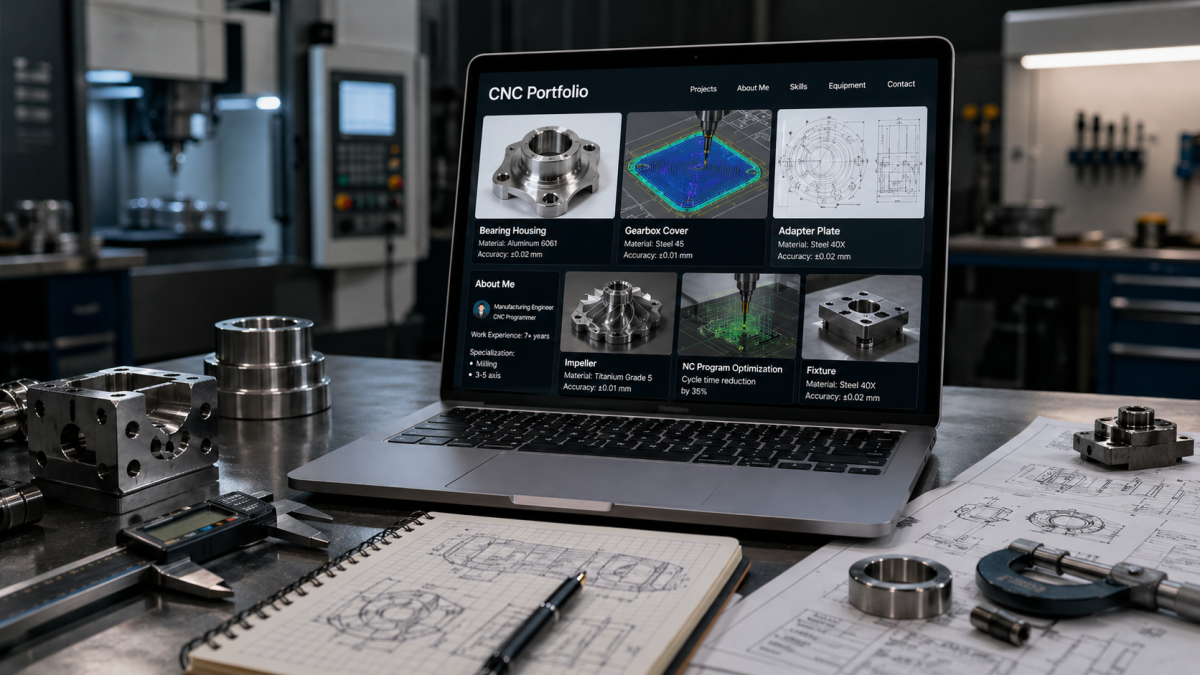
A good CNC portfolio is not a beautiful folder of part photos and not a list of machines the candidate has seen at work. An employer wants to understand something else: what the person can truly do independently, how carefully they work, how they think about quality, whether they can explain their decisions, and where the boundaries of their experience are. A portfolio should not decorate a resume; it should reduce uncertainty for the hiring manager.
In 2026, this is especially important. Companies receive many resumes with similar words: CNC operator, setup, CAD/CAM, machining, inspection, quality, production. But identical words can mean very different levels. One candidate only loaded parts according to instructions. Another launched batches, measured the first part, helped improve a process, and trained beginners. A portfolio helps show that difference before the interview.
This article explains how a CNC specialist can build a portfolio that employers actually trust: which materials to include, how to avoid exposing confidential information, how to show development, and how to make the portfolio useful for real career growth.
What an employer wants to see in a CNC portfolio
An employer looks at a portfolio not as a gallery, but as evidence. They care not only about what you did, but about what role you played in the process. If a candidate shows a photo of a part but does not explain their part of the work, trust remains low. If the candidate shows the task, constraints, actions, result, and lessons learned, the portfolio becomes much stronger.
A good portfolio answers several questions:
- which types of machines, materials, and parts the candidate has worked with;
- what they did independently and what they did under guidance;
- whether they can read drawings and understand quality requirements;
- which measuring tools they used;
- how they reacted to deviations and production problems;
- which improvements, training, or extra responsibilities they took on;
- how they document experience and whether they can explain it clearly.
This kind of portfolio helps the employer understand the candidate's level faster. It does not replace an interview or a practical check, but it makes the conversation more specific.
A portfolio must not violate confidentiality
The biggest mistake is trying to impress an employer with details that should not be shown. Many CNC specialists work with orders, drawings, materials, technologies, and customer projects protected by NDAs or internal company rules. If a candidate shows a drawing, model, part number, customer name, or production parameters without permission, it does not increase trust. It does the opposite: the employer sees risk.
A strong portfolio should show competence without exposing someone else's data. You can describe the task in general terms: aluminum housing part, small-batch steel fixture, repeatable operation on a turning center, dimensional check after setup. You can hide logos, part numbers, customer names, exact dimensions, unique fixtures, and commercial parameters.
It is better to add a short note directly: Examples are anonymized because I respect the confidentiality of previous employers. For a hiring manager, that is a good signal. It shows that the candidate understands not only the technical side, but also professional responsibility.
Which materials to include
A CNC portfolio should be short but meaningful. Usually, 6-10 strong examples are enough if each one is explained. Fewer materials with clear context are better than dozens of photos without meaning.
Useful types of materials include:
- Part photos: only if anonymized and accompanied by a description of your role.
- Setup or workstation photos: only without confidential information or unsafe practices.
- Measurement examples: description of tools used, inspection logic, and reaction to deviations.
- Improvement cases: what was unstable, what you suggested, and what result the shop floor achieved.
- Training or personal projects: especially useful for beginners who cannot show work parts.
- Certificates and courses: only relevant ones, with a short note on what they actually taught you.
- Mentor or supervisor feedback: if it is specific and confirms work behavior.
Each example should answer the question: what competence does this prove? If a material proves nothing except that you were near a machine, it is better to remove it.
How to describe each example
Employers trust not the photo, but the explanation. So each example should follow a simple structure: task, role, constraints, actions, result, and lesson learned. This helps show not only experience, but also thinking.
Example structure:
- Task: what part, operation, or production situation had to be handled.
- My role: what exactly you did independently.
- Constraints: deadline, material, tolerance, repeatability, batch, available equipment.
- Actions: how you prepared, what you checked, how you controlled quality.
- Result: stability, scrap reduction, successful batch launch, colleague training, process improvement.
- Lesson: what skill or lesson this example shows.
This structure is especially useful for candidates whose experience does not look impressive at first glance. Even an ordinary operator task can look stronger if the person shows discipline, measurement, responsibility, and process understanding.
How to show level without exaggeration
A portfolio should increase trust, not create suspicion. If a candidate writes that they independently set up complex parts but cannot explain their role during the interview, trust disappears quickly. It is better to separate levels of involvement honestly.
You can use clear wording:
- performed under mentor supervision;
- independently monitored dimensions during the batch;
- participated in first-part launch;
- helped document a recurring problem;
- suggested a change in the inspection sequence;
- trained a new operator on the basic shop-floor procedure.
This honesty does not make a candidate weaker. On the contrary, it helps the employer understand the real level and choose the right role. The riskiest strategy is to look senior on paper and then fail a practical conversation.
Portfolio for a beginner CNC specialist
A beginner may not have permission to show work parts or may not have much experience. That is normal. Early in a career, a portfolio can prove discipline, learning ability, and basic manufacturing understanding, not project scale.
A beginner can include:
- training projects from a technical school, college, course, or internal training;
- description of measuring tools learned;
- examples of reading simple drawings without exposing someone else's data;
- a photo of a neatly organized training workstation;
- a list of materials, machines, and operations already encountered;
- a short learning log: what was learned in 30, 60, and 90 days;
- mentor feedback about discipline, safety, and attention to detail.
For an employer, this may be more valuable than an empty resume with loud words. A beginner does not have to look like an experienced setup specialist. They need to show that they can learn, document experience, and respect production rules.
Portfolio for an experienced specialist
An experienced CNC specialist needs to show not simply more parts, but more depth. The employer wants to see which problems the person solved and how they affected process stability, quality, deadlines, training, or risk reduction.
Strong elements for an experienced portfolio include:
- cases of launching a new batch or new operation;
- examples of scrap reduction or repeatability improvement;
- description of interaction with quality, engineering, or production planning;
- participation in operator training or shift handoff;
- examples of working with different materials and part types;
- verified certificates, upskilling, or internal authorizations;
- stories where the candidate prevented a risk instead of only fixing an error after the fact.
Here it is especially important to write specifically, but without revealing secrets. For example, helped stabilize a repeatable operation on a steel part after dimensional problems is stronger than made complex parts.
How to format the portfolio
The portfolio should be easy to read. A hiring manager usually will not study a huge archive. It is better to create one clean PDF or web page with a clear structure. At the beginning, include a short profile: role, level, machine types, materials, measurement, and strengths. Then show 6-10 examples. At the end, include training, certificates, references, and contact details.
Each example should take limited space. The employer should quickly understand what the situation was, what the candidate did, and why it matters. If the portfolio requires a long explanation by phone, the format is weak.
A good section order:
- professional profile;
- key skills;
- work examples or cases;
- measurement and quality control;
- training and certificates;
- references or confirmations;
- contact details.
The design should be calm. Use clean headings, clear captions, good contrast, and one consistent style. In a CNC portfolio, clarity and accuracy matter more than decoration.
What not to include
Some materials make a portfolio weaker. For example, too many photos without explanations. Or screenshots that show confidential data. Or claims such as expert in everything that cannot be verified.
It is better not to include:
- drawings, models, part numbers, or customer data without permission;
- photos of unsafe work or safety-rule violations;
- dozens of similar photos without context;
- unverifiable claims of senior-level expertise;
- certificates unrelated to the role;
- complaints about previous employers;
- overly personal information unrelated to the profession.
A portfolio should work as evidence of maturity. If it shows carelessness, breach of confidentiality, or an attempt to exaggerate experience, it is worse than having no portfolio.
How to use the portfolio during an interview
The portfolio should not be sent as a heavy file without explanation. It is better to use it as a basis for conversation. In an email or message, you can write briefly: I attached a portfolio with anonymized examples of work, measurements, and production cases. It shows my actual level of involvement and growth areas.
During the interview, do not retell every page. Choose 2-3 examples that best match the vacancy. If the role is related to quality, show a measurement and deviation-response case. If the role is related to setup, show an example of participating in an operation launch. If the vacancy is for a beginner, show training, discipline, and ability to document progress.
A good candidate can explain the portfolio calmly: what they did alone, where the team helped, what the result was, and what they learned. That creates stronger trust than general statements about extensive experience.
How a portfolio helps career growth
A portfolio is useful not only for job search. It helps the specialist see their own growth. When a person records tasks, skills, mistakes, improvements, and training, they better understand where to move next.
For example, after a year it may become clear that the portfolio contains many operator tasks, but few measurement examples. Or there is experience with several materials, but no evidence of training others. Or the candidate wants to move into quality, but does not show work with reports and tolerances. This helps choose the next course, ask for a new type of task, or prepare for a conversation with a supervisor.
For an employer, such a portfolio is useful too. It shows a candidate who can think about development in a structured way instead of simply waiting for a promotion.
How CNC Passport can help
If a specialist wants to collect experience in a clearer profile, CNC Passport can be useful as a place where skills, training, confirmations, and career materials are gathered structurally. It does not replace an honest portfolio and real cases, but it helps the candidate avoid keeping the whole story only in a resume or scattered files.
For an employer, a structured profile is more convenient than a set of unlabeled photos. It helps them see faster which skills are claimed, which are supported, where training exists, and which materials the candidate is ready to show. For the candidate, it is a way to keep career history organized and avoid rebuilding proof before every job search.
The tone matters: a portfolio should prove professional maturity, not look like self-promotion. The more clearly a candidate shows experience, responsibility boundaries, and respect for confidentiality, the higher the trust.
How to keep the portfolio alive
A weak portfolio is often created once before a job search and then forgotten. A strong portfolio is updated gradually. After a new project, course, tool learned, participation in a batch launch, or useful feedback, add a short entry.
You do not need to write much. It is enough to record the date, task type, your role, skill, result, and what can be shown publicly. Every few months, review the portfolio and remove weak materials that no longer represent your current level.
This approach makes the career more manageable. The person sees which proof already exists, which gaps remain, and which tasks to ask for at the next stage.
How to know the portfolio is ready
Before sending the portfolio, it is useful to check it against a short list:
- is your role in each example clear;
- is there no confidential data;
- is there evidence of measurement, quality, or responsibility;
- does the portfolio avoid looking like a set of random photos;
- can you explain every example in an interview;
- is growth visible, not only tenure;
- is there an honest separation between independent work and mentored work;
- does the portfolio fit the vacancy you are applying for.
If the answers are positive, the portfolio already performs its main job: it helps the employer see not only resume words, but real professional context.
Final orientation
A CNC portfolio that employers trust is built on clarity, honesty, and evidence. It does not have to be loud. It has to show that the candidate understands their role, respects confidentiality, can document quality, and can explain their own experience.
The strongest portfolio does not try to look larger than reality. It helps reality become clearer. For a beginner, it is a way to show discipline and learning ability. For an experienced specialist, it is a way to prove depth, responsibility, and contribution to production. For an employer, it is a way to understand faster who they are talking to.
If the portfolio helps start a more specific conversation about work, tasks, and growth, it is already doing its job.