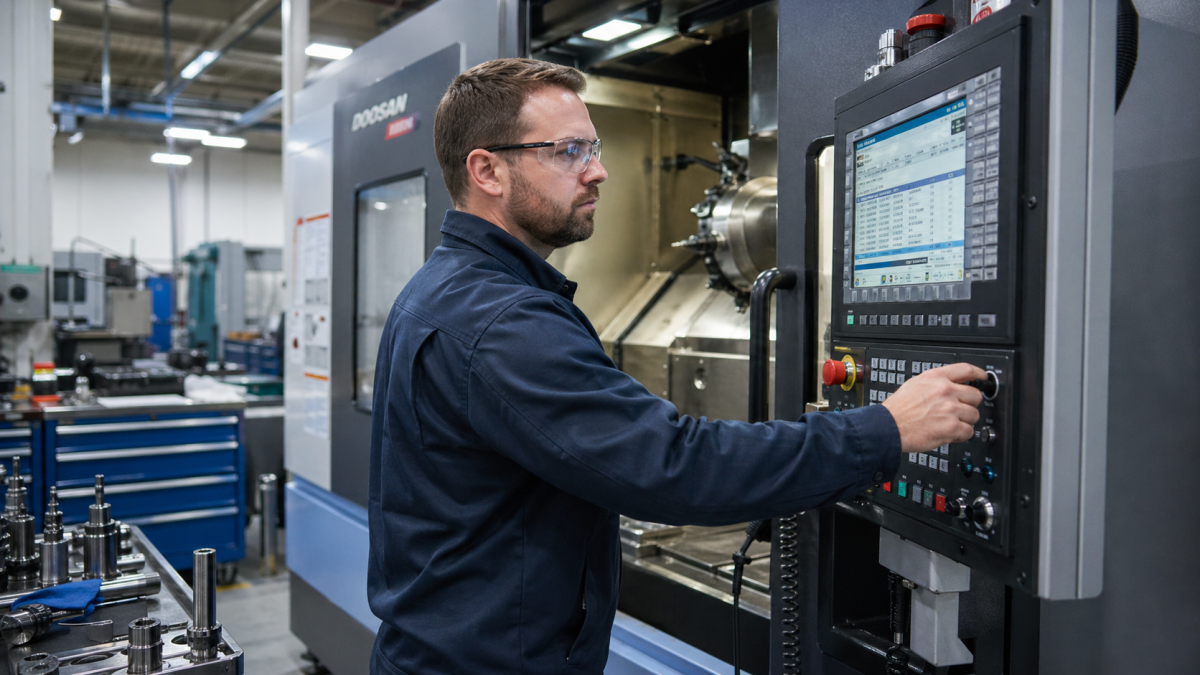
The short answer is that CNC can be a good career in 2026 and beyond, but not for everyone and not in every role. It is not an easy technical job where you learn one machine once and then work calmly for ten years without developing. A modern CNC career requires accuracy, discipline, production understanding, willingness to learn, and the ability to take responsibility for a real part, deadline, and quality result.
At the same time, CNC has a strength that is hard to replace completely: manufacturing still needs people who can turn a drawing, material, tooling, machine, and process into a stable result. Automation changes the work, but it does not remove the need for specialists who understand what is happening on the shop floor, can prevent mistakes, and can grow from operator to setup specialist, programmer, process engineer, supervisor, or manufacturing engineer.
This article is written for people choosing a profession, considering a move into CNC, already working as operators and thinking about the future, or helping a young specialist choose a technical path. We will look at where CNC offers opportunity, where the limitations are, which skills create growth, and how to decide whether this career fits you.
Why the CNC career question has become more complex
A few years ago, the answer often sounded simpler: go into CNC, shops always need skilled hands. In 2026, that answer is too broad. Several things are happening in the market at the same time. Some simple operations are being automated. Some manufacturers are adding robotic loading, more stable CAM processes, digital work instructions, and inspection systems. At the same time, experienced specialists are retiring, and many companies lack people who can work carefully, independently, and with an understanding of production risk.
So CNC is not a good career because any job beside a machine automatically creates a stable future. It is a good career for people who are ready to move above the basic role. The most durable prospects usually appear for those who can read drawings, understand measurement, learn setup, see the causes of scrap, work with documentation, communicate with process engineers, and gradually take on more responsibility.
In other words, the future is not simply with the button-pushing operator. It is with the specialist who becomes a useful part of the production process.
What market data says
It is important to look at the market realistically. For example, data from the U.S. Bureau of Labor Statistics for machinists and tool and die makers shows a mixed picture: in the United States, overall employment in this group is projected to decline slightly from 2024 to 2034, but tens of thousands of openings are still expected each year because workers transfer to other occupations or leave the labor force. BLS also reports that in 2024 the median annual wage for machinists was $56,150, and for tool and die makers it was $63,180. Source: BLS Occupational Outlook Handbook.
Those numbers should not be copied mechanically to every country or region. Germany, Poland, Czechia, the United States, Canada, Mexico, Turkey, Ukraine, and Asian markets will differ by wages, industry mix, and access to training. But the broad lesson is useful: CNC is not a field where the number of jobs grows endlessly by itself. It is a field where quality, flexibility, and the ability to handle more complex work become more valuable.
For a candidate, this means that if you want to build a strong CNC career, you should not focus only on entering the occupation. You should think about the next level from the beginning.
Who CNC careers fit
CNC fits people who like practical technical work. It is important to see the connection between a drawing, material, tool, machine, and finished part. The work often requires patience, attention to detail, and respect for procedures. A mistake can cost not only time, but also an expensive blank, a tool, an order, or safety.
Good signs that CNC may fit you include:
- you are interested in how accurate parts are made from raw material;
- you are comfortable with measurement, tolerances, and repeatability;
- you can keep attention on details for long periods;
- you dislike chaotic work without rules and standards;
- you like finding out why a process produced a bad result;
- you are ready to learn from more experienced people and ask questions;
- you are comfortable in a production environment, not only at a computer.
This career may fit less well if someone wants quick results without a long learning period, dislikes responsibility for accuracy, struggles with a noisy manufacturing environment, or is unwilling to follow safety rules. CNC can be intellectual and interesting work, but it remains manufacturing work, not an office abstraction.
Where the path usually starts
Many people begin as operators. That is a normal entry point if the company truly trains people and offers a clear growth path. At the start, a person learns the machine, part, measuring tools, workstation, documentation, basic procedures, quality control, and production discipline.
But it is important to separate a good start from a dead end. A good start is when the operator gradually gains understanding: why the part is measured in a certain way, how the operation works, what affects the dimension, how to read a drawing, how to record deviations, and how to communicate with a setup specialist or supervisor. A dead end is when a person only loads and unloads parts for years, receives no explanation, learns nothing, and sees no next step.
Before accepting a first CNC job, it is worth asking the employer:
- whether there will be on-the-job training;
- who will mentor you during the first weeks;
- which skills can be learned in 3-6 months;
- whether there is a path from operator to setup operator or another role;
- which measuring tools are used every day;
- how the company handles beginner mistakes and training;
- whether there are internal instructions, checklists, and standards.
The answers will show whether the company offers a career entry point or simply needs someone for a repetitive operation without development.
Which roles exist inside a CNC career
CNC is not one single profession. It is a group of roles, and movement between those roles is what makes the career interesting. On one shop floor, a person may start with basic operator work and then move into setup, quality control, programming, process preparation, or shift leadership.
Typical growth directions include:
- CNC operator: works with an established process, loads parts, checks dimensions, and watches operation stability.
- Setup operator: prepares the machine for work, installs fixtures and tools, checks the first part, and helps launch new batches.
- CNC machinist: understands machining, materials, tooling, measurement, and the causes of operation problems more deeply.
- CAM programmer: prepares machining in CAM software and works with models, strategies, tools, and process constraints.
- Quality technician: specializes in measurement, reporting, tolerances, CMM work, and quality stability.
- Manufacturing engineer or process engineer: improves processes, reduces scrap, optimizes operations, and connects design and production work.
- Team leader or supervisor: is responsible for people, the shift, deadlines, training, and process discipline.
The further someone moves beyond a basic repetitive operation, the more communication, documentation, root-cause analysis, ability to train others, and understanding of the manufacturing business matter.
Which skills create the best growth
In CNC, some skills quickly separate a promising specialist from someone who merely works beside a machine. The first is drawing reading. If a person understands dimensions, tolerances, datums, surface finish, and inspection requirements, they become useful to production faster.
The second is measurement. Knowing how to use calipers, micrometers, indicators, gauges, height gauges, or CMM equipment is not a formality. It is the language of trust between operator, setup specialist, quality control, and process engineering.
The third is process understanding. Why is the dimension drifting? Why did vibration appear? Why is the tool wearing faster? Why is the first part good, while the tenth is already off? These questions make a person valuable because they begin preventing problems instead of only reporting them after scrap appears.
The fourth is working with digital tools. CAD/CAM, electronic work instructions, spreadsheets, production systems, digital skill profiles, and reports are becoming normal. Not every CNC specialist has to be a programmer, but confidence with computers and production data is becoming more important.
The fifth is professional communication. A strong specialist can explain a problem briefly, hand off a shift, record a deviation, ask a process engineer a clear question, and avoid hiding risk. In real manufacturing, this affects career growth as much as the technical base.
Automation: threat or opportunity
Automation really is changing CNC work. Simple repetitive operations are easier to standardize. Robots can load parts. CAM systems are becoming easier to use. Sensors and inspection systems provide more information. Some tasks that used to require manual experience become part of a configured process.
But automation does not make good specialists unnecessary. It changes the question: companies need fewer people who only perform one action, and more people who can support a stable system. Someone has to understand why the process stopped, why quality drifted, where preparation is weak, why an operator does not understand an instruction, how to train a new person safely, and how to make a shift more predictable.
For a career, this means you should not compete with automation at the level of the simplest action. It is better to become the person who can work beside an automated process, understand its limits, and improve it.
Advantages of a CNC career
A CNC career has several strong advantages. First, it is a practical profession with a visible result. You are not only working on an abstract task; you see finished parts, assemblies, and products that may be used in machinery, medicine, aerospace, energy, transport, or toolmaking.
Second, it is a path where a person can grow without a mandatory university route. Formal education helps, but in many cases a strong combination of practice, mentoring, technical courses, discipline, and a skills portfolio can create good professional growth.
Third, CNC opens different directions. You can become a strong shop-floor practitioner, move into programming, go into quality control, develop into process engineering, become a supervisor, or build a career in manufacturing management.
Fourth, good CNC specialists are often valued because their work directly affects quality, deadlines, and cost. If a person helps reduce scrap, stabilize a process, and train others, their contribution is easy to see.
Drawbacks and risks to know in advance
CNC should not be romanticized. A production environment can be physically and mentally demanding. There may be shifts, noise, standing work, strict deadlines, responsibility for expensive parts, and the need to follow safety rules. In some companies, training is weak, processes are chaotic, and beginners are thrown into work without normal mentoring.
Another risk is becoming stuck in a role that is too narrow. If someone performs only one operation for years and gains no new skills, their mobility in the labor market decreases. That experience may look like tenure, but it does not always create real career capital.
It is also important to understand that pay depends heavily on region, industry, shift pattern, part complexity, independence level, and company culture. Two jobs with similar titles can differ greatly. So when choosing a job, look not only at the title, but also at the real tasks.
How to know whether this career is good for you
Before entering CNC, it is useful to answer several questions honestly. Do you like precision? Are you ready to learn through practice, mistakes, and repetition? Are you interested in understanding the cause of a problem, not only following an instruction? Does a production environment suit you? Do you want to take on more responsibility over time?
If most answers are positive, CNC may be a good choice. If you are attracted only by stable work but not interested in parts, measurement, process, and learning, another technical direction may fit better. In CNC, it quickly becomes clear who truly wants to understand manufacturing and who is simply looking for a job without development.
A useful test is to try a short course, a factory visit, an internship, a conversation with a practicing specialist, or assistant work on a shop floor. A real impression of the shop often teaches more than dozens of articles about the profession.
How to build the career from the first years
A strong CNC career rarely happens by accident. Even in the first year, it is worth keeping a personal skills map: which machines you have seen, which materials you have worked with, which measuring tools you have learned, which drawings you have read, which problems you helped solve, which courses you completed, and what you learned from a mentor.
It is useful to ask for feedback not only in the form of whether your work is okay, but more specifically: what needs to improve for you to move to the next level? Which mistakes repeat? Which skill will open access to more complex tasks? What distinguishes a strong setup operator or technician in this company?
It is also important to collect proof of development: certificates, projects, descriptions of processes learned, recommendations, examples of improvements, participation in launching new parts, and experience training beginners. This helps in interviews and makes career growth more manageable.
Mistakes that block growth
The first mistake is thinking that tenure by itself equals qualification. Employers look not only at the number of years, but at what the person can actually do independently.
The second mistake is avoiding measurement and drawings. Without them, a specialist remains dependent on others and cannot confidently move to a more complex role.
The third mistake is staying silent about problems. In manufacturing, hidden risk is almost always worse than an open question. A person who reports doubt or deviation in time is often more valuable than someone who pretends everything is clear.
The fourth mistake is choosing a job only by starting pay. Sometimes a workplace with a good mentor, clear process, and growth after a year is stronger than a higher starting rate in a chaotic company without training.
The fifth mistake is not developing communication. In CNC, it matters not only to work with your hands, but also to explain, hand off information, learn from others, and help the team work more consistently.
What will be valued after 2026
After 2026, value will come not only from individual technical operations, but from combinations of skills. Manufacturing needs people who connect practice, quality, data, discipline, and training. The better a specialist understands the full path from part requirement to stable result, the more resilient they are in the labor market.
Especially promising combinations include:
- operator experience plus strong measurement;
- setup plus quality understanding;
- shop-floor practice plus CAD/CAM;
- production experience plus training beginners;
- technical foundation plus communication with engineers and managers;
- ability to work with equipment plus ability to improve the process.
These combinations are harder to replace with simple automation because they are tied not to one action, but to understanding the production system.
How to make the decision
A CNC career in 2026 and beyond can be a good choice if you want to build a practical technical profession, are ready to keep learning, and understand that growth comes through responsibility. It is not the easiest path, but it can be stable and interesting for people who like real manufacturing.
The best approach is to enter the profession with open eyes. Look not only at the job title, but at training, mentoring, tasks, safety culture, equipment quality, and growth path. Ask what you can learn in the first months. Compare not only pay, but also the future value of the experience.
If you are ready to develop from simply performing operations toward understanding the process, CNC can provide not just a job, but a professional trajectory. In this career, the people who win are those who combine precision, curiosity, discipline, and respect for manufacturing.
Sources for factual orientation: U.S. Bureau of Labor Statistics, Machinists and Tool and Die Makers.