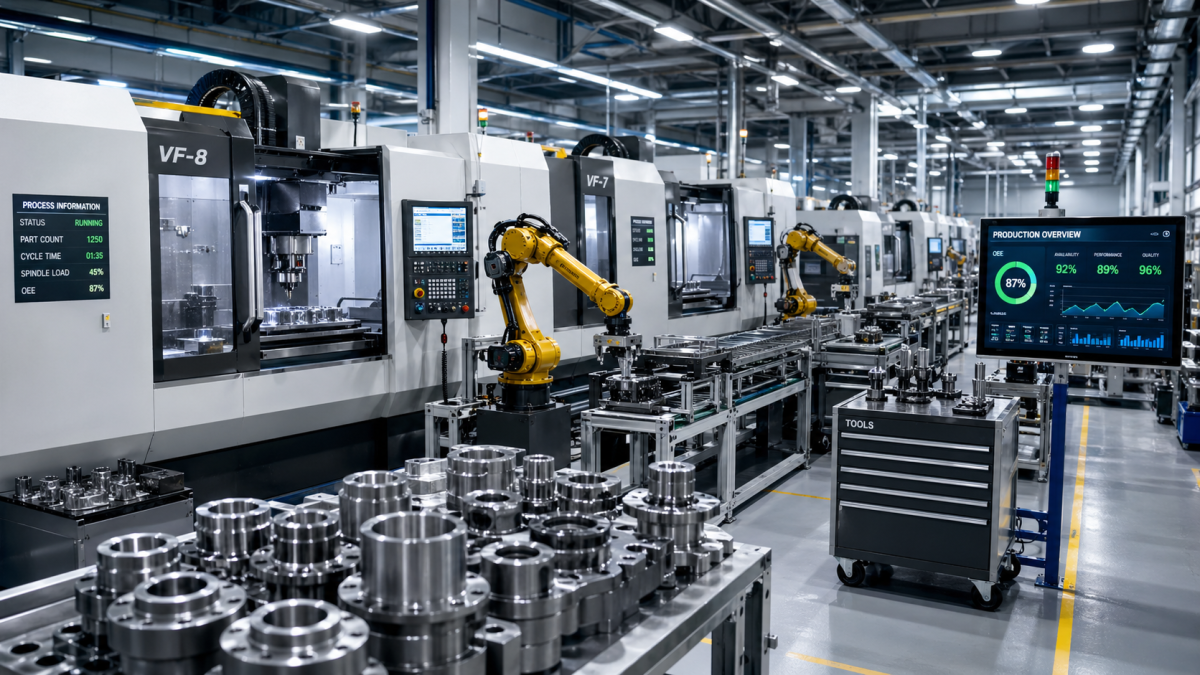
Automation on the shop floor rarely arrives like a glossy film about the factory of the future. Usually it arrives in a more ordinary way: a robot appears beside the machine, then pallets, sensors, remote monitoring, tool presetting, or a new habit of looking not only at the part but also at downtime, tool life, and scrap data. At first it irritates people. Then it becomes clear that the old way of working from memory and feel does not always hold up.
The main fear is easy to understand. If the machine becomes smarter, does the specialist become less necessary? At the weak end of the job, yes, automation removes some simple work. But in a serious shop, human value does not disappear. It moves. Less value goes to the person who only starts a familiar operation. More value goes to the person who prevents an automated system from producing an expensive mistake quickly.
Automation is not about the button; it is about responsibility around it
The most dangerous illusion is that an automated cell will compensate for weak preparation. It will not. If blanks are loaded incorrectly, the tool is already on the edge, the clamp is dirty, the offset was entered without logic, and the first inspection is delayed, the robot will repeat the problem faster and more calmly than a person.
This is where the specialist stays valuable. Not by arguing with automation, but by understanding its weak points. Check that the blank is really seated. Notice that the same stop returns after a tool change. Understand why the sensor did not trip randomly. Do not ignore a strange sound just because the cell is supposed to know what it is doing.
This is no longer the work of someone who only services a machine. It is the work of someone who guards the boundaries of the process. Automation repeats well. If it receives bad conditions, it repeats the bad conditions too.
Measurement becomes more important, not less
When the machine runs alone, a measurement mistake becomes more expensive. On a manual operation, an operator may notice trouble by the part, the sound, the chip, or the pause between actions. In an automated run, that pause may not exist. If the inspection point is chosen badly, the batch can move forward while everything still looks tidy on the screen.
So the career advantage goes not to the person who merely knows measuring tools, but to the one who understands inspection logic. Which dimension is checked first. Where the part may move after unclamping. When a caliper is enough, and when a micrometer, bore gauge, or CMM check is needed. Where inspection belongs at the start, and where it only slows the process for no real reason.
If a specialist cannot measure, automation will not save them. It will only remove some manual noise and leave the weak point visible.
Data is not analysis for its own sake
Modern shops increasingly ask not how it felt, but what happened. How long was the stop? On which operation did repeated scrap appear? After which tool change did the dimension move? Why did the night shift produce fewer parts with the same program?
Not every operator needs to become a data engineer. But the person who can record a usable fact becomes noticeably more helpful. Operation number, tool, stop reason, dimension before correction, dimension after correction, clamp condition, repeat pattern: this is not bureaucracy if the note helps tomorrow's shift avoid yesterday's problem.
A poor note saying only that the machine was down helps nobody. A good note saves time for the supervisor, process engineer, and next shift. Sometimes these small details show who works as part of the process and who is simply waiting for the shift to end.
Do not fear the robot; fear becoming invisible
A robot, loader, or pallet system rarely removes every person around the machine. But it changes what the manager can see. In the past, being busy could be mistaken for being valuable. In an automated cell, that is harder. A person may walk near the machine all day and improve almost nothing. Or they may notice one bad sequence that costs the cell ten minutes every cycle.
Value becomes visible through the questions a specialist asks. Why does this fault repeat after the third pallet? Why does the tool consistently fail before the expected count? Why does the automatic cycle need manual help in the same place? Why is the first part after setup good, while the fifth is already doubtful?
These questions do not sound heroic. They save hours. And sometimes they separate the person who stays close to automation from the person who slowly gets pushed back to the simplest tasks.
What to improve first
There is no need to grab everything at once: robots, CAM, sensors, macros, reports, digital twins. That is an easy way to get an impressive list and no real growth. It is better to choose honestly the weak point that is already hurting the work.
- If every setup still requires waiting for a more experienced employee, build the setup foundation first.
- If disputed dimensions always go to the supervisor, start with measurement and inspection method.
- If stop reasons are written in vague words, learn to record facts that others can actually use.
- If the automated cell often needs manual intervention, study the sequence, clamping, tooling, and repeat pattern.
Automation does not have to be a threat. But it has little patience for professional vagueness. The more the machine does by itself, the more important it becomes to have someone who understands where the process can break, how to check it, and what to pass on clearly. The value of a CNC specialist in 2026 is not standing beside the button. It is seeing what the button cannot understand.