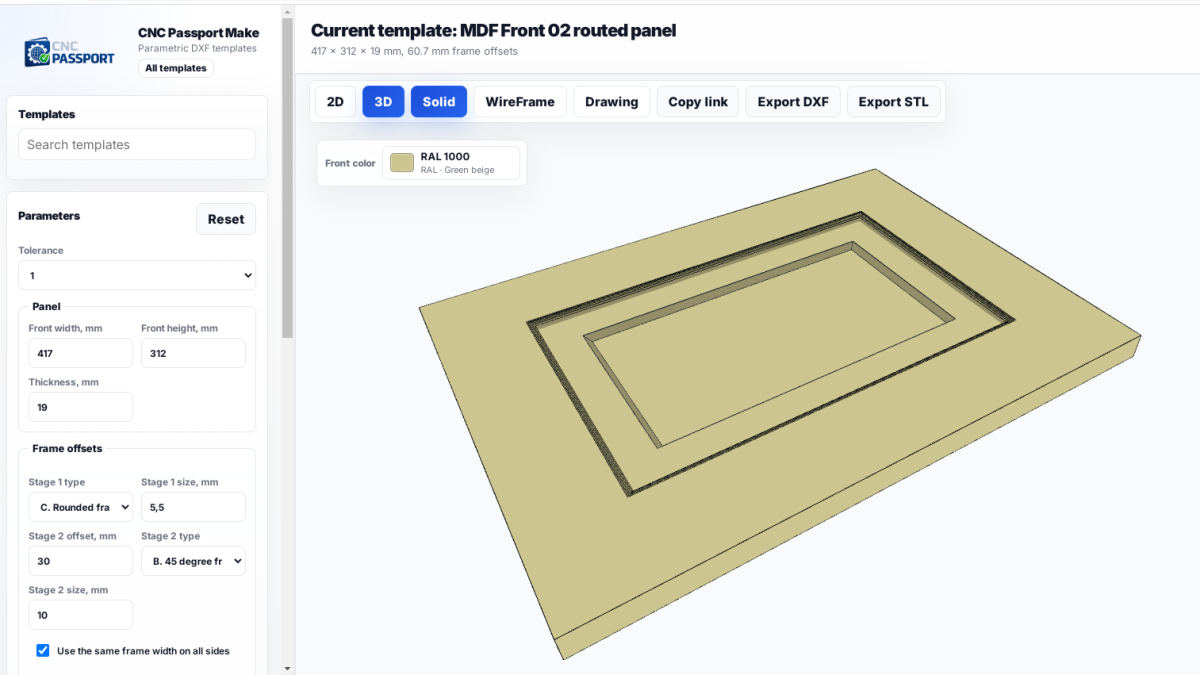
With MDF fronts, the same decision comes up again and again: build everything from scratch or work from a prepared base. On paper, a fully custom design looks more impressive. On the shop floor and in the design office, what usually wins is not perfect freedom but a set of templates that has already survived production and does not fall apart on the first revision.
MDF front templates are not there to force everyone into identical solutions. Their job is more practical: remove repetitive manual work, shorten the time needed to agree on dimensions, and stop the designer from having to remember the same edge-band, milling, radius and clearance limits every time.
Where a template saves the most time
The biggest gain does not come from complex signature fronts. It comes from ordinary repeat work. Kitchen doors, hinged fronts, filler parts, series built around one profile, repeated cabinet units and upper sections - this is where a template removes unnecessary questions. If the project already has proven geometry, there is no need to recheck basic offsets, handle position, recess depth or paint allowance each time.
A good template acts as a short path between sketch and production. The designer sees which shapes can actually be built without unnecessary struggle, and the technologist gets a model that is easier to launch into work. That does not remove checking, but it makes it shorter and more honest: instead of asking whether the front can be made at all, the conversation becomes about a specific thickness, size and finish.
In practice, this matters most when the sales team promises a fast lead time and the designer is sitting on a stack of almost identical orders. Where every new file is assembled manually without a library of solutions, errors build up quietly: the wrong allowance here, a missing groove there, a front that no longer fits the milling setup. A template does not make the job beautiful on its own, but it does reduce the number of pointless decisions.
What a template should contain
Empty geometry is rarely enough. A working MDF front template must include more than an outline. It should include the things that usually appear at the least convenient moment: board thickness, edge type, allowed series dimensions, hinge reference points, cutter limits and a clear logic for mirrored versions. Without that, the template becomes a picture instead of a tool.
It is even more important that the template does not hide production limits. A designer can draw a beautiful arch or a complex profile, but if the library does not say what cuts it, where chip-out becomes a risk and what allowance is needed for finishing, the template will create friction instead of removing it. That is why useful libraries usually live next to technical notes, not apart from them.
- base series dimensions and acceptable tolerances;
- standard hinge, handle and drilling positions;
- radius and cutter-profile limits;
- notes on edge banding, painting and sanding;
- left-hand and right-hand variants.
Why some templates help and others get in the way
The problem is usually not the idea of templates itself, but the way they are maintained. If a library is not updated after real production runs, it quickly starts lying. It keeps dimensions that once worked on paper but no longer pass on the actual tool or in the current finishing process. Then the designer trusts the library and the shop ends up fixing someone else’s confidence.
There is another extreme as well: too many templates, tiny differences between them, and nobody knows which one is current. In that kind of system nobody saves time. People just spend longer looking for the right file. A small number of truly live solutions is more useful than a huge archive where half the fronts look similar but behave differently.
The most practical test is simple: if a template lets a new employee build a standard front without constant follow-up questions, it is useful. If opening the file immediately turns into a round of calls and messages about allowances, recess depth and edge treatment, that is no longer a library. It is a source of extra confusion.
When a ready-made solution beats authorial freedom
Full freedom in design looks strong only until the first deadline slips. In serial orders and standard furniture lines, the advantage often comes not from uniqueness but from repeatability. Ready-made MDF front templates let the team stop reinventing the same detail and focus on what actually changes the product: proportions, finish, how it sits with the cabinet, the handle and the visual rhythm.
That does not mean all non-standard fronts should disappear. It means the non-standard part should be deliberate, not accidental. If every third model needs manual rework simply because the company has no proper library of standard solutions, you pay for the absence of a standard twice: first in designer time, then in production time.
Templates work best where there is already discipline in handoff between departments. Then the designer is not guessing and is taking a proven contour. The technologist does not spend an evening decoding yet another “roughly like this”. Production gets a predictable file. And it turns out that project speed depends less on heroics and more on how carefully the library has been put together.
If the company needs to speed up standard MDF front launches without losing control, that is where the work should start. Not with another pretty mockup, but with a set of solutions that can actually be repeated tomorrow morning without extra clarification.