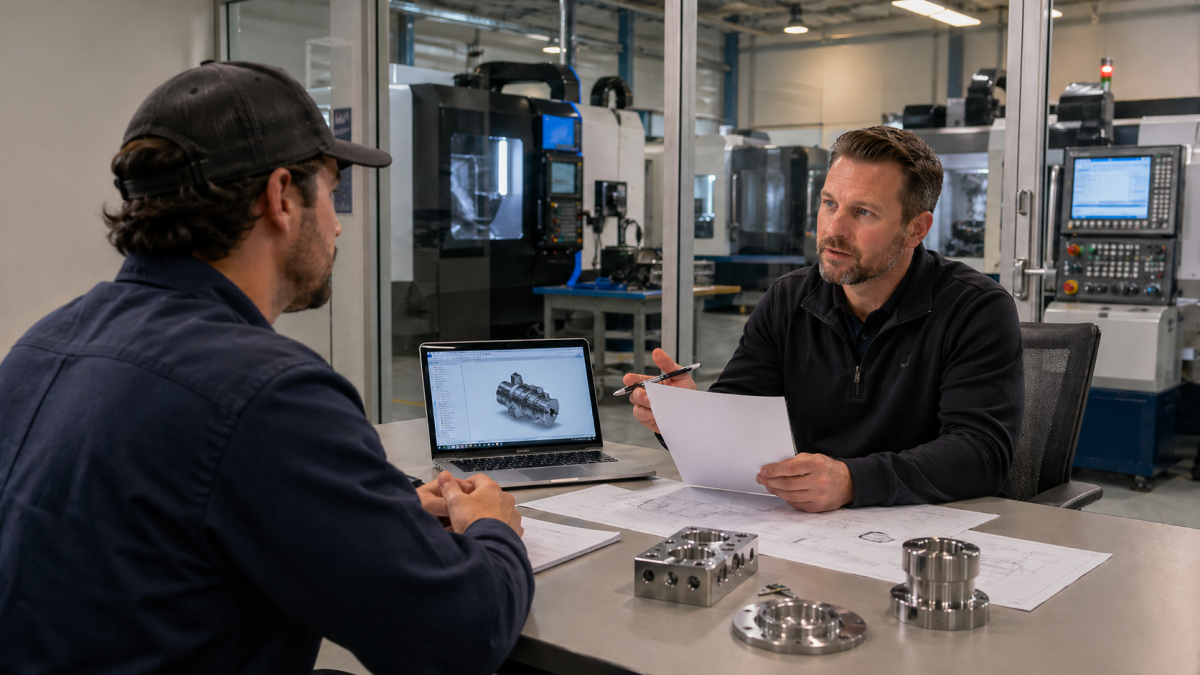
An interview with a CNC specialist often fails not because the applicant is weak. It fails earlier: when the vacancy is described in general words, the shop supervisor expects one level, HR searches for another, and the posting says a tidy phrase like “experience with CNC machines.” In the conversation, that quickly turns into a strange exchange of guesses.
The employer asks about experience. The person says they worked on a machining center. Then it turns out that this shop needs independent setup, short runs, first-part inspection, night-shift work, and the ability not to pull the process engineer into every doubtful dimension. That is no longer the same vacancy.
Before the interview, the first thing to check is not the applicant. It is the position itself.
First, define who you are really looking for
The job title rarely says enough. “CNC operator” in one company means loading blanks and inspecting by instruction. In another, it means setup, offsets, tool changes, several operations, and discussion with quality control over doubtful dimensions. If this is not separated in advance, the interview will be noisy but not very useful.
The most common mistake is looking for a “strong specialist” without honestly describing the work. Strong for what? Serial loading? Independent changeovers? Small batches? A night shift with no process engineer nearby? The answers change not only the requirements but also the pay range.
Five things to clarify before the meeting
This is not a formal HR checklist. It protects the interview from a situation where everyone believes they discussed the same job, while in fact they talked about different work.
- Which machines and controls will be used: mills, lathes, multitasking machines, Fanuc, Siemens, Haas, Heidenhain, or another system.
- What the person must do independently: only run, inspect, adjust offsets, change tools, perform basic setup, or launch a new batch completely.
- What type of production dominates: serial work, small batches, one-off parts, repeatable operation, or constant changeovers.
- Where responsibility ends: when the operator decides alone, when the supervisor is called, and when the process engineer or quality team enters.
- Which conditions affect the work: shifts, nights, multi-machine supervision, manual loading, pallets, robot, blank shortages, or weak tool presetting.
If there are no answers to these questions, the interview should probably wait. Otherwise the employer will judge confidence in conversation instead of the fit between the person and the job.
Where resumes almost always mislead
Resumes rarely lie directly. More often they are simply too smooth. “Work on CNC machines” may mean five years beside one stable operation. “Setup” may mean tool replacement by instruction. “Quality control” may turn out to be checking two dimensions, not understanding datums, tolerance, and the first part.
Before the interview, it helps to mark the places that need to be opened up more concretely. Not to catch someone in an inaccuracy. The same words mean different things in different shops. This is especially true for setup, programming, measurement, multi-machine work, and independence.
A good question for a resume is not “is this true?” but “under what conditions did this happen?” Long cycle or short? One part or constant changeovers? Ready program or adjustment at the machine? Inspection by control plan or independent choice of measuring method?
Check the shop, not only the person
Sometimes a company is looking for a worker who is expected to cover problems created not by the vacancy, but by the organization of the shop. There is no clear shift handoff. Tools are searched for in the morning. Blanks arrive late. Quality control is overloaded. The supervisor keeps in his head what should have been written down.
In that situation, even a good new employee quickly looks weaker than they are. They ask many questions because the rules are not assembled. They lose time because nobody said where their responsibility ends. They make mistakes in local habits because those habits are not described anywhere.
Before the interview, decide honestly: are you hiring someone for a normal process, or someone who will carry an unfinished process on their back? The second option is possible, but it is a different level, different money, and a different conversation.
What to bring into the interview
After this preparation, the interview becomes shorter and sharper. There is no need to circle around general words for a long time. The conversation can test the key points directly: equipment, independence, part type, inspection, shift, and support during the first weeks.
It is useful to bring one real work situation into the conversation. No closed drawings and no unnecessary details. For example: a short batch, the first part has a doubtful dimension, the machine is waiting for a decision, and the supervisor is busy. What does the person check first? Where do they stop? What do they write down? Whom do they call? This kind of review shows more than the question “how many years of experience?”
Before interviewing, the employer should remove at least its own fog. If the vacancy is assembled clearly, the conversation becomes specific. If not, even a strong specialist may be answering for a job that does not really exist.